ads

.
javascript:void(0)
Showing posts with label Parasitology. Show all posts

Nov 26, 2010

Family Oestridae..Genus Oestrus (Nasal Bot Flies)

  • Larvae of these flies spend most of their time in the nasal passage of sheep & Goat. So called nasal bots
  • Adult flies are having short life span (1 week) whereas larvae having 1 year or more of life span.
Morphology
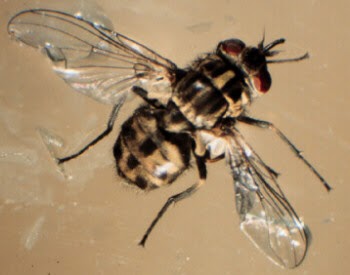
  • Adult flies are 1cm in size and of grey color.
  • Small dark spots are present on the abdomen with a covering of short brown hair.
  • Size of Larvae is 3cm and color is yellowish white. Larva is tapering anteriorly with prominent step posteriorly.
  • Body is segmented having dark transverse bands dorsally (each segment).
Nasal Bot fly injecting larvae
Life Cycle
  • Adult female is viviparous and produce larvae.
  • Sheep become infected by squirting of jet of liquid containing larvae.
  • During the flight, fly deliver 25 larvae.
  • Newly emerged larva is 1mm in length.
  • Larva migrates from nasal passage to frontal sinuses.
  • Larva feed on mucous secreted by movement of larva.
  • In the nasal passage, larva mould to L2.
  • In the frontal sinuses, larva completes their development and then migrates to nostrils where they are active throughout the year.
  • Become dormant in winter season if temperature is below 18.
  • From the nostrils, L3 larvae fall on the ground and from larva, pupa develops.
  • From the pupa, adult emerges. Adult having very short life span
  • Survive for only 1 week and during this period, produce about 500 larvae.
Pathogenic effects
  • Itching and Irritation
  • Rubbing the nostrils against hard objects
  • Nasal discharge which later on becomes mucopurulent
  • In coordination, convulsions
  • Also called false gid (signs resembling coenurus cerebralis)
  • Cause swelling of eyes in human called as keratoconjunctivitis and inflammation of lips called stomatitis
  • Loss of weight
Treatment
  • Refoxanide, Ranide…. 1ml/25kg BW subcutaneously
  • Nitroxynil, Trodex….1ml/20kg BW subcutaneously
  • Ivermectin………….1ml/50kg BW subcutaneously
Control
Regular use of insecticidal drugs should be followed.

Family Oestridae..Genus Hypoderma (Warble Flies)

These are hairy flies.
Adult flies having primitive and non-functional mouth parts.
Adult life span is short.
Larva having functional mouth parts and long life span
There are 3 important generas;
  • Hypoderma
  • Oestrus
  • Gaterophilus
Genus Hypoderma
  • Also called warble flies
  • Cause great economic losses
  • Affect cattle, buffalo, sheep, goat, equines and sometimes human beings.
  • These flies are present mainly in lower Punjab areas.
  • Species include;
  • H. Bovis
  • H. Liniatum
Morphology
  • These flies resemble honey bees.
  • Have one pair of wings, Yellow orange abdomen having yellow orange hair with a broad band of black hair in middle.
  • Larva size is 2.5-3cm and color is dirty white when emerges but becomes dark brown later on.
  • Larva is barrel shaped and segmented body. Each segment bears spines.
  • Larva is tapering interiorly and color of pupa is black.
Life cycle
  • Adult flies are active during warm month of the year and lay eggs.
  • Egg attaches to the lower region of the leg having hairs. H.Bovis has single eggs but H.Liniatum eggs are in a row of 6. Eggs of H.Bovis are above hock region and that of H.Liniatum are below hock region.
  • Egg hatch and larva develop (L1). Size of L1 larva is 1mm. L1 crawl down the Hair, Penetrate Hair follicles and reaches the Diaphragm region. This migration is aided by paired mouth hooks and secretion of proteolytic enzymes.
  • From the diaphragm, L1 move toward resting site during autumn. Resting site of H.Bovis is epidural fat of spinal canal and that of H.Liniatum is sub mucosa of esophagus.
  • They spend winter over there.
  • With the onset of spring season, L1 mould to L2 and become active and move toward skin of back.
  • With the onset of summer season, L2 mould to L3. L3 can be seen under the skin. These come out of the skin and fall on the ground. They move in the soil for some time.
  • From the larva, pupa and from the pupa, adult emerges.
  • Adult copulate, female lay eggs and then die within 1-2 weeks.
Pathogenic Effects
  • Creates disturbance and cause restlessness for the animals and human beings due to buzzing noise
  • Greenish yellow gelatinous mass is formed on the damaged skin of back and it is called as Butcher Jelly.
  • Due to buzzing noise, meat production is reduced and also milk production.
Treatment & Control
  • Ivermectin…. Ivotec, Ivomec (1ml/50kg B.W subcutaneously)
  • Use insecticides;
  • Organo Chlorine…… DDT, hexachlorocyclohexane/ benzene hexachloride
  • Organic phosphate…. Trichlorofen, neguvan, cumafex, neocidal, diazinon and asuntal
  • Synthetic pyrethroid...Cypermethrine and Ecoflee
  • Carbamates
  • To treat toxicity, Atropine sulphate is used.

Family Muscidae..Genus Glossina (TseTse Flies)

  • Also called TseTse flies
  • Some classify it in family muscidae and some in Glossinidae family.
  • It is found in Africa on more than 10 million kilometer area.
  • It is important vector of many Human & Animal diseases.
Morphology
  • Adult flies are long, narrow and yellow to dark brown in color.
  • Size is 6-15mm and mouth is projecting forward.
  • Wings held over the abdomen like a pair of close scissors when at rest.
  • Mouth parts are composed of U-shaped Labium with rasp labella which lie at the terminal region of Labium and upper sharp labrum.
  • B/W Labium and Labrum, Hypopharynx is present which carries salivary duct and delivers anticoagulant to Host tissue.
  • In the center of the wings, there lies hatchet or cleaver.
Life Cycle
  • Female is viviparous and produce 8-12 larvae in its life time.
  • Maturation of larva takes place in 10 days.
  • Size of larva is 8-10mm.
  • Color of larva is creamy white and segmented body and ear shaped Protuberance which is used for respiration.
  • From the larva, pupa develops. Pupa stage is 4-5 weeks. Pupa is barrel shaped and Dark brown in color.
  • From the pupa, adult emerges. Adult requires several blood meals for a period of 16-20 days before ovary matures and egg laying starts.
Pathogenic Effects
  • Create great restlessness for animal and human beings.
  • It causes production losses.
  • These flies are important vectors of Trypanosomiasis (human & animals).
Treatment & Control
  • Use insecticides;
  • Organo Chlorine…… DDT, hexachlorocyclohexane/ benzene hexachloride
  • Organic phosphate…. Trichlorofen, neguvan, cumafex, neocidal, diazinon and asuntal
  • Synthetic pyrethroid...Cypermethrine and Ecoflee
  • Carbamates
  • Destroy the bushes.
  • Killing of the game animals which act as reservoir of infection because these animals provide blood to flies is necessary.
  • Trap the flies with black cloth and kill them. It is the best method.

Nov 10, 2010

Family Muscidae..Genus Stomoxy (Stable Flies)

  • Also called as stable flies
  • These are biting house flies. Bite of the fly is very painful.
  • These are important vectors of many helminthes and protozoan infections.
  • Specie important is S. Calcitran.
Morphology
  • Size if 5.5-7.5mm and color of the fly is grey.
  • Four dark, longitudinal stripes are present on the thorax.
  • Mouth (proboscis) is projected forward.
  • Mouth part is composed of labium, labrum and hypopharynx which carries salivary duct and delivers anticoagulant into host tissue.
Life Cycle
  • Adult female lay eggs on decaying organic matter or rotting material or wheat straw, rice straw and hay contaminated by urine and feces of animals.
  • Eggs are laid in batches. Each batch contains 25-50 eggs.
  • Egg hatch in 1-4 days depending upon the environmental conditions.
  • From the egg, larva develops. Larva maturation takes place in 6-30 days depending upon the environmental conditions. 27-29°C is the optimum temperature for larval development.
  • From the larva, pupa emerges.
  • From the pupa, adult emerges.
  • It requires 12-60 days for completion of life cycle (egg-adult).
  • Adult requires several blood meals before ovary matures and egg laying starts.
Pathogenic Effects
  • Mouth parts swing downward and penetration of skin is achieved by rasping effect of teeth which lies at the end of the labium.
  • It is very painful bite for animal.
  • 3 minutes are required for a complete blood meal.
  • Feeding is often interrupted thus allowing pathogenic organisms to enter into the body of flies and multiply there.
  • Same fly when sucking blood from another animal, transmits the pathogenic organism into the other animal.
  • Habronema (nematodal infection) and Trypnosomiasis (protozoan infection) are transmitted by these flies.
  • Creates restlessness for the animal and human beings
  • It causes production losses of 20-25 %.
  • Prefer strong sunlight to live and present in abundance on building and farm.
Treatment & Control
  • Provide good hygienic conditions.
  • Destruction of breeding places is very much important.
  • Proper drainage of the area is very important.
  • Use insecticides;
Organo Chlorine…… DDT, hexachlorocyclohexane/ benzene hexachloride
Organic phosphate…. Trichlorofen, neguvan, cumafex, neocidal, diazinon and asuntal
Synthetic pyrethroid...Cypermethrine and Ecoflee
Carbamates
  • Use of flies repellant sprays such as spoton and sporon.
  • Valuable animals must have ear tags, nose ring and tail bands impregnated with insecticides.
  • Lower the animal movement during maximum activity of flies.

Nov 6, 2010

Family Muscidae..Genus Hematobia (Horn Flies)

These are called Horn flies.
These are smallest blood sucking flies which are responsible for the transmission of filarial worms.
There are 3 main species;
  • H. Irritans
  • H. Stimulans
  • H. Exigua
Host is cattle and buffalo.
Morphology:
  • Size of adult fly is 4mm and it is of grey color.
  • Several dark stripes are present on thorax.
  • Abdomen is dark green in color and shorter than musca.
  • Mouth part is projected forward and called as proboscis.
  • Pulps are long and stout.
  • Mouth part consists of Hypopharynx, Maxilla, mandibles, labium and labrum.
  • Flies lay egg on freshly passed feces.
  • Flies remain on host and leave the host when to go on another host.
Life Cycle:
  • Flies lay egg on freshly passed feces.
  • Size of egg is about 1-1.5mm.
  • Egg hatch immediately and larva develop.
  • 27°C is the ideal temperature for larval development. Low temperature delays development.
  • From the larvae, pupa develops within 6-8 days.
  • From pupa, adult emerges and adult remains on the host.
Pathogenic Effects:
  • Flies are present in abundance on the ventral abdomen, side and back of the animal and suck blood.
  • When not sucking blood, these are present around the pole and cause great irritation and restlessness for animal.
  • Due to constant irritation, create wounds that attract other flies and result in blow fly myiasis. This also leads to secondary bacterial Infections.
  • These flies create Great economic losses. It is responsible for transmission of filarial worms.
Treatment & Control:
  • Use sprays on animal.
  • All of the drugs discussed previously apply on this too.
  • Control of these flies is very easy because these live on host.

Classification of Arthropods

Phylum Arthropoda:
Class Insecta:

Order Diptera:
Class Arachnida:
Difference b/w Insects and Arachnids:

Oct 28, 2010

Family Muscidae..Genus Hydrotaea(Head Flies)

Hydrotaea Irritans is the only important specie. Commonly called Head flies
It contains non-obligatory and non-biting flies.
These are important vector of many diseases.
Morphology:
  • Size is 5.5-7.5 mm.
  • Thorax is having longitudinal stripes.
  • Abdomen color is olive green.
  • Yellow, orange coloration at the base of the wing
  • Mouth parts are adapted for sponging and composed of Labella (labium), labrum, maxilla, mandibles and hypopharynx.
  • Labium is having sharp teeths. Maxilla and mandibles are rudimentary.
  • Hypopharynx carries salivary duct delivers anticoagulant to host tissues.
Life Cycle:
  • Adult flies are active during midsummer. These flies prefer to live in still conditions. These live in woodland and plantation.
  • Adult lay eggs on decaying organic matter or rotting material.
  • Egg hatch and larva develop. Maturation of larva takes place during autumn season.
  • Larva undergoes hibernation. With the onset of spring season, larva become active and pupa develop.
  • With the onset of summer, adult emerges from pupa.
  • There is only one generation in a year.

Pathogenic Effects:
  • Flies are abundant around the base of the horn in the form of the clusters.
  • As these flies feed on lacrimal secretions, wound secretions.
  • Labella is adapted for sponging and having sharp teeth which create wound due to rasping effect of teeth. This condition sometimes cause extension of wound and resemble blow flies myiasis. This also led to secondary bacterial infections.
  • Flies are also abundant on ventral potion of abedomen and udder.
  • Flies cause summer mastitis by transmitting Streptococcus disgalactie and corynebacterium pyogenes. 
Treatment & Control:
  • All of the drugs used in genus musca apply here too.
  • Sings of toxicity include shivering, sweating, salivation, and diarrhea. Antidote is atropine sulfate.
  • Medicated water should not fall on ear, eyes, nose and mouth. So, use muzzle when injecting.
  • Use of flies’ repellant (sporon, spoton)
  • Use ear tags, nose rings and tail bands impregnated with insecticides.
  • Provide good hygienic conditions.
  • Proper drainage of marshy areas is very important.

Family Muscidae..Genus Musca(House Flies)

It contains both biting and non biting flies.
Bite of flies is very painful.
Feed on decaying organic matter and wound secretions.
They cause restlessness for human being and animals.
Generas
  • Musca (House Flies)
  • Hydrotaea (Head Flies)
  • Haematodia (Horn Flies)
  • Stomozy (stable flies)
  • Glossina (Tse Tse flies)
Genus: Musca
Species:
This genus contains two important species;
  • Musca Domestica (house flies)
  • Musca autumnalis(face flies)
Morphology:
  • Size is 5.5-7.5 mm. color variable from light to dark grey.
  • Poor longitudinal stripes on the thorax
  • Color of abdomen is grey, light or dark marking.
  • Complex mouth part is present which is adopted for sponging.
  • Mouth part is composed of Labrum, Labium, Maxilla, Mandibles and Hypopharynx. Maxilla and Mandibles are rudimentary.
  • During feeding, mouth part is prominent.
  • A pair of wings having veins is present. Veins are very helpful is differentiating different species of flies.
  • Presence of sticky hair on pad like structures is the most important morphological feature which lies at the end of claw leg. Germs stick with this hair.

Life cycle:
  • Adult flies lay egg on decaying organic matter or rotting material.
  • Color of eggs is creamy white and banana shaped.
  • Eggs are in badges, each badge is having 100 eggs.
  • Egg hatch within 12-24 hours depending upon the environmental conditions.
  • Egg hatch and white, segmented and cylindrical larva develop.
  • There are 3 larval instars. L1-L2-L3.
  • Development of larva takes place in 3-7 days. Anterior end of larva is pointed and having a pair of hooks. Posterior end of larva is blunt and having respiratory spiracles.
  • Larva move to dry area and pupa develop. Color of the pupa is brown or black and is barrel shaped.
  • From pupa adult emerges. Development from egg to adult takes 3-26 days.
 
Pathogenesis:
  • It causes restlessness to livestock and human beings.
  • Flies are important vectors of many bacterial and parasitic infections. These cause mastitis by transmitting bacteria to healthy animals. It also transmits Anthrax Spores.
  • Habronema(parasite) and Relletenia (worm) eggs are also transmitted by flies.
  • Parafilaria bovicola is also transmitted by these flies.
  • M. autumnalis feed on lacrimal and nasal secretions and are responsible for transmission of eye worm (thelazia) which causes Pink eye disease. It also causes mastitis and Infectious Bovine Conjunctivitis (IBC).
Treatment and Control:
  • Provide good hygienic conditions.
  • Destruction of breeding places is very much important.
  • Proper drainage of the area is very important.
  • Use insecticides;
  • Organo Chlorine…… DDT, hexachlorocyclohexane/ benzene hexachloride.
  • Organic phosphate…. Trichlorofen, neguvan, cumafex, neocidal, diazinon and asuntal.
  • Synthetic pyrethroid...Cypermethrine and Ecoflee.
  • Carbamates
  • Use of flies repellant sprays such as spoton and pouron.
  • Valuable animals must have ear tags, nose ring and tail bands impregnated with insecticides.
  • Lower the animal movement during maximum activity of flies.